
Introducing Dynova
All-in-one cybersecurity service, led by a virtual CISO in the UAE
All-in-one cybersecurity service, led by a virtual CISO in the UAE
All-in-one cybersecurity service, led by a virtual CISO in the UAE
Dynova provides virtual CISO services in Dubai and across the UAE as one monthly subscription: a named CISO of record, a delivery team that writes the policies and builds the controls, continuous penetration testing and 24/7 monitoring. ISO 27001, SOC 2, PDPL, VARA and CBUAE compliance gets built, not described.
Dynova provides virtual CISO services in Dubai and across the UAE as one monthly subscription: a named CISO of record, a delivery team that writes the policies and builds the controls, continuous penetration testing and 24/7 monitoring. ISO 27001, SOC 2, PDPL, VARA and CBUAE compliance gets built, not described.





Introducing vCISO services
Introducing vCISO services
Virtual CISO services in the UAE: One monthly subscription for growing businesses.
Virtual CISO services in the UAE: One monthly subscription for growing businesses.
Experienced vCISO Assigned
Experienced vCISO Assigned
A vCISO (virtual Chief Information Security Officer) is a named senior security executive who leads your security programme on a recurring basis and stays accountable for the outcome.
A vCISO helps your company or startup to:
‣ Identify and prioritize risks.
‣ Develop and implement cybersecurity strategies.
‣ Oversee security across people, processes, and technology.
‣ Provide technical support for architecture, testing, and control implementation.
‣ Manage security due diligence for clients, partners, and investors.
A vCISO (virtual Chief Information Security Officer) is a named senior security executive who leads your security programme on a recurring basis and stays accountable for the outcome.
A vCISO helps your company or startup to:
‣ Identify and prioritize risks.
‣ Develop and implement cybersecurity strategies.
‣ Oversee security across people, processes, and technology.
‣ Provide technical support for architecture, testing, and control implementation.
‣ Manage security due diligence for clients, partners, and investors.



Security Team
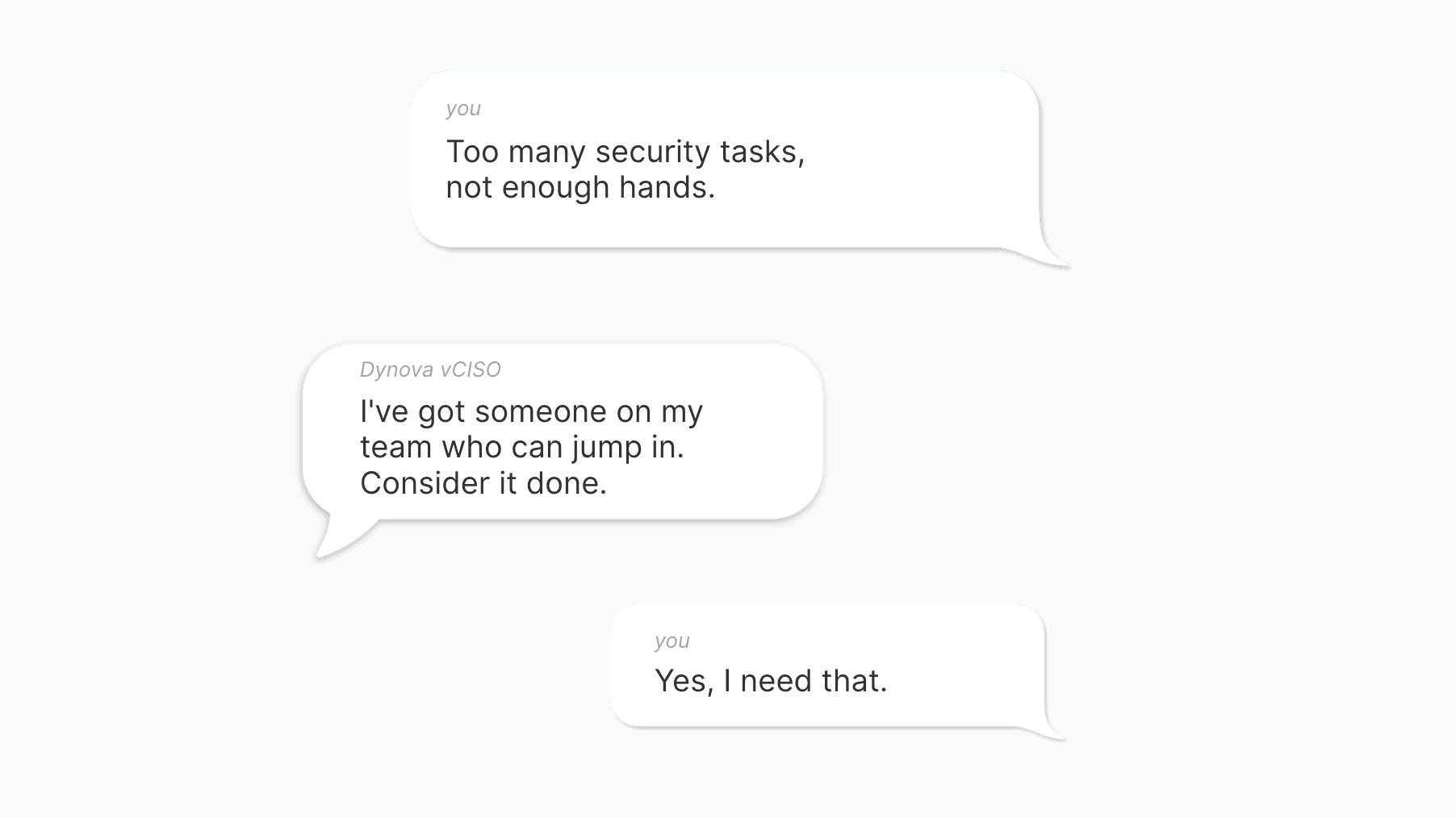
Your vCISO does not have to do everything personally. Our full-time in-house penetration testers, security engineers and GRC analysts work alongside the named CISO, on top of the CISO's own hours, so policies get written, controls get built and findings get closed without waiting on your team's spare capacity.
Access to GRC Platform
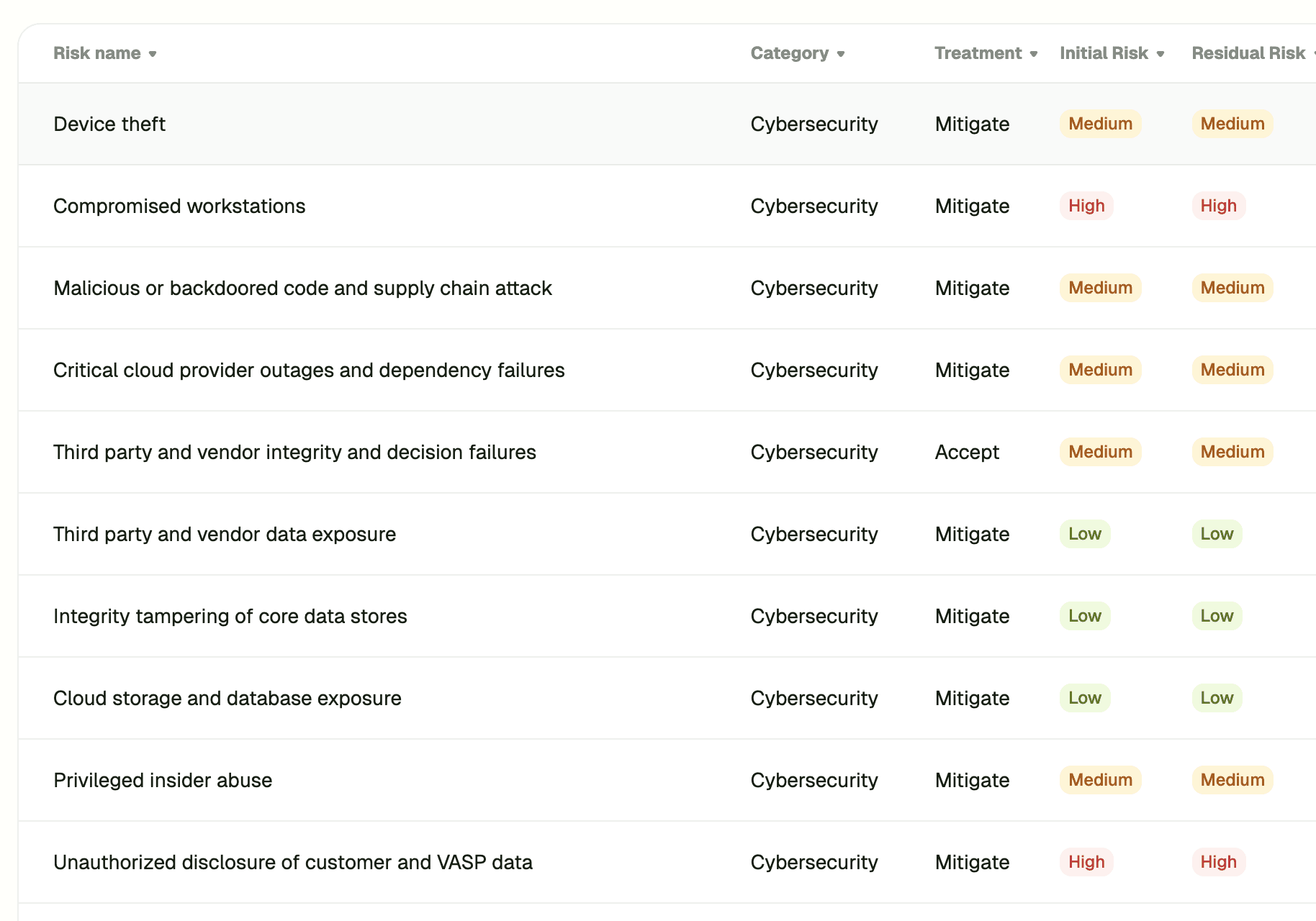
Track progress in our GRC platform, included in the vCISO service. Monitor all cybersecurity and privacy progress in one place, including pending tasks, open risks, compliance readiness, controls, vendor assessments and audit findings.
Track progress in our GRC platform, included in the vCISO service. Monitor all cybersecurity and privacy progress in one place, including pending tasks, open risks, compliance readiness, controls, vendor assessments and audit findings.
COMPLIANCE
From zero to audit-ready. Done for you.
From zero to audit-ready. Done for you.
We build real security from the ground up, so compliance follows naturally, not from a folder of templates. We run the assessment, implement the controls, and represent you in the audit.









Working under a different framework? Ask, we likely cover it

Dynova is a British Standards Institution (BSI) Associate Consultant for ISO 27001 and ISO 27701. Learn what it means.
Dynova is a British Standards Institution (BSI) Associate Consultant for ISO 27001 and ISO 27701. Learn what it means.
Process
Process
vCISO consulting that secures your growth
vCISO consulting that secures your growth
vCISO consulting that secures your growth
Discovery
Build
Monitor

Workflow start
Customer initiates payment
Tokenize card
3DS challenge triggered
Call Payment Provider API
Finalize
Yes
Webhook signature verified?
No
Quarantine
01 – Discovery
Reveal gaps, vulnerabilities and risks
In the first 30-60 days, we run a structured discovery in two phases. Business Discovery maps how your organization actually operates - revenue streams, critical processes, regulatory exposure, stakeholders. Technology Discovery goes into the architecture and workflows behind it: systems, integrations, data flows, access paths.
From there, we apply a risk methodology agreed with the business, perform threat modeling and risk assessment, and present findings to the board. Where relevant, we also run penetration testing - especially for organizations that have never been independently tested.
02 – BUILD
Build and Execute The Strategy
We translate assessment findings into a board-ready strategy, secure leadership alignment, and move into execution. Unlike advisory-only providers, we deliver the strategy end-to-end — backed by our GRC tool and Security on Demand team that implements controls, hardens existing systems, and runs required testing. A typical 12-month strategy covers certifications like ISO 27001, PCI DSS, or SOC 2.
03 – Monitor
Stay Compliant and Monitor Your Security
After execution, Dynova’s vCISO leads audits end-to-end through to certification and continuous compliance. To strengthen your security posture further, Dynova provides an in-house 24/7 UAE-based SOC built specifically for startups: AI-powered, affordable, and tightly integrated. The vCISO becomes your escalation point and incident coordinator — with minimal involvement required from your team.
Discovery
Build
Monitor
Workflow start
Customer initiates payment
Tokenize card
3DS challenge triggered
Call Payment Provider API
Finalize
Yes
Webhook signature verified?
No
Quarantine
01 – Discovery
Reveal gaps, vulnerabilities and risks
In the first 30-60 days, we run a structured discovery in two phases. Business Discovery maps how your organization actually operates - revenue streams, critical processes, regulatory exposure, stakeholders. Technology Discovery goes into the architecture and workflows behind it: systems, integrations, data flows, access paths.
From there, we apply a risk methodology agreed with the business, perform threat modeling and risk assessment, and present findings to the board. Where relevant, we also run penetration testing - especially for organizations that have never been independently tested.
02 – BUILD
Build and Execute The Strategy
We translate assessment findings into a board-ready strategy, secure leadership alignment, and move into execution. Unlike advisory-only providers, we deliver the strategy end-to-end — backed by our GRC tool and Security on Demand team that implements controls, hardens existing systems, and runs required testing. A typical 12-month strategy covers certifications like ISO 27001, PCI DSS, or SOC 2.
03 – Monitor
Stay Compliant and Monitor Your Security
After execution, Dynova’s vCISO leads audits end-to-end through to certification and continuous compliance. To strengthen your security posture further, Dynova provides an in-house 24/7 UAE-based SOC built specifically for startups: AI-powered, affordable, and tightly integrated. The vCISO becomes your escalation point and incident coordinator — with minimal involvement required from your team.
Discovery
Build
Monitor
Workflow start
Customer initiates payment
Tokenize card
3DS challenge triggered
Call Payment Provider API
Finalize
Yes
Webhook signature verified?
No
Quarantine
01 – Discovery
Reveal gaps, vulnerabilities and risks
In the first 30-60 days, we run a structured discovery in two phases. Business Discovery maps how your organization actually operates - revenue streams, critical processes, regulatory exposure, stakeholders. Technology Discovery goes into the architecture and workflows behind it: systems, integrations, data flows, access paths.
From there, we apply a risk methodology agreed with the business, perform threat modeling and risk assessment, and present findings to the board. Where relevant, we also run penetration testing - especially for organizations that have never been independently tested.
02 – BUILD
Build and Execute The Strategy
We translate assessment findings into a board-ready strategy, secure leadership alignment, and move into execution. Unlike advisory-only providers, we deliver the strategy end-to-end — backed by our GRC tool and Security on Demand team that implements controls, hardens existing systems, and runs required testing. A typical 12-month strategy covers certifications like ISO 27001, PCI DSS, or SOC 2.
03 – Monitor
Stay Compliant and Monitor Your Security
After execution, Dynova’s vCISO leads audits end-to-end through to certification and continuous compliance. To strengthen your security posture further, Dynova provides an in-house 24/7 UAE-based SOC built specifically for startups: AI-powered, affordable, and tightly integrated. The vCISO becomes your escalation point and incident coordinator — with minimal involvement required from your team.
vCISO Network
vCISO Network
vCISO Network
Named vCISOs with UAE regulatory experience
Named vCISOs with UAE regulatory experience
Named vCISOs with UAE regulatory experience
We match each engagement with a vCISO whose background fits your sector and stage — drawing from a wider network beyond the leaders shown here.
We match each engagement with a vCISO whose background fits your sector and stage — drawing from a wider network beyond the leaders shown here.



From the Best of the Middle East
From the Best of the Middle East
From the Best of the
Middle East
OUR CISO AWARDS

CISO Excellence Award 2025
CISO Excellence Award 2025

CISO Award Winner 2025
CISO Award Winner 2025

Top Cybersecurity Leader 2025
Top Cybersecurity Leader 2025
Official service provider

Hub71 Service Provider

Shorooq Service Provider
Featured IN


Finance
E-commerce
Healthcare
SaaS
Real Estate
Logistics
Crypto
Education
Industries
Industries
Built for the real world. Across every industry.
Built for the real world. Across every industry.
Built for the real world. Across every industry.
Finance
vCISO services align banks, fintechs, and VASPs with CBUAE, VARA, and UAE IAR — embedding controls that satisfy regulators without slowing product velocity.
E-commerce
From PCI DSS scoping to fraud and account-takeover defense, we secure payment flows, customer data, and marketplace integrations — protecting revenue and PDPL compliance.
Healthcare
We align clinics, health-techs, and insurers with UAE health data laws (ADHICS, DoH, MoHAP), securing patient records and medical systems without disrupting care delivery.
Crypto
We guide exchanges, custodians, and Web3 startups through VARA and ADGM requirements — wallet security, key management, and audit-ready controls for licensing.
SaaS
vCISO services get UAE SaaS companies to ISO 27001 and SOC 2 so enterprise deals stop stalling in security review.
BENEFITS
BENEFITS
1-2 days of vCISO per week gives you
1-2 days of vCISO per week gives you
1-2 days of vCISO per week gives you
Audit and Assessment
Risk identification and gap analysis aligned with UAE IAR, ISO 27001, and sector frameworks.
Strategy Development
Ongoing CISO advisory and a practical security roadmap tied to business goals, regulatory deadlines, and budget
Controls Implementation
Hands-on rollout of policies, technical controls, and processes that hold up under audit.
Privacy and DPO Services
ROPA, DPIAs, and data subject handling under UAE PDPL, GDPR, and regional privacy laws.
Compliance Achievement
Natural path to compliance with ISO 27001, PCI DSS, SOC 2, and UAE regulators — including on-site audit representation.
Regular Reporting
Board-ready KRIs and monthly metrics leadership actually reads and acts on.
Compare
Why Choose Dynova
Why Choose Dynova
Why Choose Dynova
Stop overpaying for full-time CISOs or under-investing in part-time advisors. Get senior security leadership matched to your stage, sector, and regulatory requirements.
Traditional Approach
Full-time CISO cost
Slide decks, no execution
Fragmented services
Remote consultants, no regional context

Named vCISO of record, 4 to 16 hours per week
Hands-on implementation
One subscription, GRC tool and team included
Senior CISOs, local presence
Testimonials
Testimonials
Real results. Real teams. Powered by vCISO.
Real results. Real teams. Powered by vCISO.
Real results. Real teams. Powered by vCISO.

"Working with Dynova's vCISO, we built our information security from the ground up in just six months — including assessments, penetration testing, full security controls implementation, and ISO 27001 certification with BSI. The Dynova vCISO became an integral part of our startup family."
Ahmed Abdeltawab
CEO, O Gold
6
months from zero to certification
"Working with Dynova's vCISO, we built our information security from the ground up in just six months — including assessments, penetration testing, full security controls implementation, and ISO 27001 certification with BSI. The Dynova vCISO became an integral part of our startup family."
Ahmed Abdeltawab
CEO, O Gold
6
months from zero to certification

"InsuranceMarket.ae™ has 500+ employees in the UAE and an internal security team, but Dynova's vCISO brings the senior leadership layer we needed: gap identification, strategy, and execution. They also drive our UAE IAR, ADHICS, and PDPL compliance — at 5x the cost-efficiency of a full-time CISO."
Hussain Fakhruddin
CTO, InsuranceMarket.ae™
5x
cost-efficiency
"InsuranceMarket.ae™ has 500+ employees in the UAE and an internal security team, but Dynova's vCISO brings the senior leadership layer we needed: gap identification, strategy, and execution. They also drive our UAE IAR, ADHICS, and PDPL compliance — at 5x the cost-efficiency of a full-time CISO."
Hussain Fakhruddin
CTO, InsuranceMarket.ae™
5x
cost-efficiency

"Dynova joined us as virtual DPO to align our smart-city startup with UAE PDPL. Despite the complexity of operating street cameras and video analytics in public spaces, we reached full compliance in under three months without a single regulatory issue. That experience was strong enough that we've now extended the engagement to build out our security program."
Stepan Kasatkin
CEO, Citix MENA
150K+
USD saved vs full-time CISO/DPO
"Dynova joined us as virtual DPO to align our smart-city startup with UAE PDPL. Despite the complexity of operating street cameras and video analytics in public spaces, we reached full compliance in under three months without a single regulatory issue. That experience was strong enough that we've now extended the engagement to build out our security program."
Stepan Kasatkin
CEO, Citix MENA
150K+
USD saved vs full-time CISO/DPO
Pricing
Plans built for speed and scale
Plans built for speed and scale
Plans built for speed and scale
*Save 10% on yearly plans.
Advisor
Yearly
Your named vCISO sets direction, your people execute.
$2,500
/ mo
4 h/week of vCISO time
Assessment & prioritization
Ongoing advisory and decision support
ISO 27001-aligned policies
Architecture & control reviews
Due diligence support
Quarterly board report
Advisor
Yearly
Your named vCISO sets direction, your people execute.
$2,500
/ mo
4 h/week of vCISO time
Assessment & prioritization
Ongoing advisory and decision support
ISO 27001-aligned policies
Architecture & control reviews
Due diligence support
Quarterly board report
Builder
Yearly
Your vCISO builds security for you. Direction, delivery and accountability.
$4,500
/ mo
8 h/week of vCISO time
Security strategy & execution
Hands-on controls implementation
Certification preparation
Deputy CISO included
Named DPO of record & privacy program
GRC Platform
Builder
Yearly
Your vCISO builds security for you. Direction, delivery and accountability.
$4,500
/ mo
8 h/week of vCISO time
Security strategy & execution
Hands-on controls implementation
Certification preparation
Deputy CISO included
Named DPO of record & privacy program
GRC Platform
Team
Yearly
Your vCISO and a security team, for the cost of one hire. The fastest delivery.
$8,500
/ mo
16 h/week of vCISO time
Everything in Builder, plus:
Security engineering team
Continuous penetration testing
External audit representation
Incident response & coordination
Priority SLA
Team
Yearly
Your vCISO and a security team, for the cost of one hire. The fastest delivery.
$8,500
/ mo
16 h/week of vCISO time
Everything in Builder, plus:
Security engineering team
Continuous penetration testing
External audit representation
Incident response & coordination
Priority SLA
3-month minimum term on monthly plans, then change or cancel anytime.
Yearly plans are billed annually.
Need only a DPO? Named DPO of record from $1,900/mo. Read more.
3-month minimum term on monthly plans, then change or cancel anytime.
Yearly plans are billed annually.
Need only a DPO? Named DPO of record from $1,900/mo. Read more.
Does your startup need 24/7 monitoring and response?
24/7 threat detection and response from our dedicated security team, on a UAE-based SIEM. Led by vCISO.
From $3,900 / mo
Does your startup need 24/7 monitoring and response?
24/7 threat detection and response from our dedicated security team, on a UAE-based SIEM. Led by vCISO.
From $3,900 / mo
Get started
Tell us about your company
Share a few details about your company and security goals. Our team will review your message and respond within one business day.
Prefer to talk? +971 54 458 8631

Tell us about your company
Share a few details about your company and security goals. Our team will review your message and respond within one business day.
Prefer to talk? +971 54 458 8631
Get started

Tell us about your company
Share a few details about your company and security goals. Our team will review your message and respond within one business day.
Prefer to talk? +971 54 458 8631
Get started
FAQ
Frequently asked questions
What is a Virtual CISO (vCISO)?
A Virtual CISO (vCISO), also referred to as a fractional CISO, outsourced CISO, CISO as a Service, or part-time CISO, is an experienced security executive engaged on a recurring, contractual basis to lead an organization's information security program without the cost or commitment of a full-time hire. Unlike a one-off consultant, a vCISO carries ongoing accountability: defining security strategy, owning the risk register, reporting to the board or executive committee, liaising with regulators, and leading response when incidents occur. Engagements are typically scoped in hours per month or as a fixed monthly retainer, scaling up during audits, incidents, or compliance milestones.
How does a Virtual CISO differ from a Managed Service Provider (MSSP) or external consultants?
A Virtual CISO becomes part of the organization's leadership on a recurring basis, taking on defined responsibilities similar to an internal executive. Unlike an MSSP or external consultant, a vCISO is accountable for shaping security strategy, ensuring regulatory alignment, and reporting to leadership or the board. Over time, a vCISO is typically embedded into daily operations — issued a company email address, granted system access, and authorized to act on the organization's behalf with auditors, regulators, and counterparties. MSSPs and consultants, by contrast, deliver time-bound or ticket-based services and remain external to the organization's decision-making structure.
When should a company hire a vCISO instead of a full-time CISO?
A vCISO is the right choice when an organization needs senior security leadership but cannot justify the cost or workload of a full-time hire. Typical triggers include preparing for a regulatory inspection (VARA, CBUAE, SCA, ADGM FSRA, DIFC DFSA), pursuing ISO 27001 or PCI DSS certification, responding to client or counterparty security questionnaires that require a named CISO, recovering from a security incident, or scaling the security function during fundraising or M&A due diligence. A full-time CISO becomes appropriate once headcount, revenue, and threat exposure justify the fully loaded annual cost of a senior in-house executive. Below that threshold, a fractional CISO delivers the same governance function at a fraction of the cost, with the same regulatory standing.
Can a Virtual CISO be appointed as the formal CISO under UAE regulations (VARA, CBUAE, ADHICS, UAE IAR)?
Yes. None of these frameworks requires the security lead to be a full-time employee, though each sets the requirement differently. VARA's Technology and Information Rulebook requires every licensed VASP to appoint a CISO, who cannot also be the Compliance Officer. ADHICS requires entities that handle health information in Abu Dhabi to appoint a CISO or an equivalent resource (Section 2.1.3). The UAE Information Assurance Standards make a senior security owner mandatory through control M1.1.3, which is Always Applicable. CBUAE has no single rule that names a CISO: its technology risk requirements sit in the regulation for each licence type, and for payment providers Article 13 of the Retail Payment Services and Card Schemes Regulation sets the UAE Information Assurance Standards as the minimum, M1.1.3 included. A vCISO can be appointed by board resolution, named in regulatory filings and sign attestations for the company, provided the contract defines the scope of authority and the person meets the regulator's competence and fit-and-proper expectations. Entities in the DIFC and ADGM fall under the DFSA and FSRA rather than the federal standards, so the appointment is assessed against those regimes.
Can the same person serve as both vCISO and DPO under UAE PDPL?
In most cases, yes. UAE PDPL (Federal Decree-Law No. 45 of 2021) does not prohibit combining the Data Protection Officer (DPO) and CISO functions, and the two roles are operationally complementary: the CISO owns technical and organizational security controls, while the DPO owns lawful basis, data subject rights, cross-border transfer mechanisms, and breach notification obligations. A conflict of interest would arise only if the same person also determines the purposes and means of processing, a position held by executive management or business unit owners rather than by a security or privacy officer. In a combined engagement Dynova names one person to both roles, and those decisions stay with the client, so the separation that matters is preserved.
What does a vCISO actually do day-to-day?
A vCISO engagement — whether labeled virtual, fractional, or outsourced CISO — typically starts with a discovery and assessment phase: stakeholder interviews, asset and data inventory, control gap analysis, threat modeling, and formulation of a security strategy aligned with the organization's regulatory exposure and risk appetite. The output anchors the rest of the engagement: ISMS policy framework, enterprise risk register, and a board-approved remediation roadmap. Once strategy is agreed, the vCISO shifts into recurring operational mode: daily-to-weekly contact with business, IT, engineering, and any internal or on-demand security team executing the plan. Recurring responsibilities include compliance tracking (ISO 27001, PCI DSS, SOC 2, ADHICS, UAE PDPL), risk monitoring, vendor risk review, oversight of penetration testing, board and regulator reporting, and incident response leadership. The specific scope varies with the contracted hour band — a 4-hour-per-week retainer concentrates on governance, board reporting, and exception handling, while a 16-hour-per-week engagement allows the vCISO to lead execution directly alongside the internal team.
How is a vCISO engagement priced, and who carries liability?
Dynova prices vCISO engagements (also called fractional or outsourced CISO) as a fixed monthly retainer for a defined number of hours per week, typically 4, 8, or 16. The price depends on the hour band, the seniority of the assigned executive, and the regulatory complexity of your environment, from a governance retainer at the lower end to embedded security leadership at the upper end. The retainer includes participation in incident response during business hours on a best-availability basis. Continuous monitoring and 24/7 response come from the separate SOC service, where the vCISO acts as the escalation point and security lead. Liability follows control. Dynova and your named vCISO are responsible for performing the contracted services with professional skill and care: the assessments, the advice, the policies and controls we deliver, our support in audits and regulator contact, and the accuracy of what we report to your board. If we fall short of that standard, Dynova is liable under the services agreement. We do not guarantee that an incident will never occur, because no provider can. Risk acceptance stays with you. Your executive management or board decides which risks to accept, defer, or fund, including risks you choose not to remediate against our advice, and we record those decisions in the risk register. The SOC service has its own scope and service levels, and liability for monitoring and response failures is measured against them. The financial limits for each service are set out in the services agreement.
Is a fractional CISO the same as a virtual CISO?
Yes. Fractional CISO, virtual CISO, outsourced CISO and CISO as a Service describe the same arrangement: a senior security executive engaged part-time under contract rather than hired full-time. What differs between providers is not the label but whether they only advise or also execute. Dynova's Advisor plan is the fractional model; Builder and Team add a delivery team that builds the controls.
How much does a virtual CISO cost in the UAE?
Dynova's plans are public: Advisor at $2,500 per month for 4 hours a week, Builder at $4,500 for 8 hours plus hands-on implementation and a named DPO of record, and Team at $8,500 for 16 hours plus a security engineering team and continuous penetration testing. A standalone DPO without a vCISO starts at $1,900 per month and a 24/7 startup SOC starts at $3,900. Monthly plans have a 3-month minimum term.
FAQ
Frequently asked questions
What is a Virtual CISO (vCISO)?
A Virtual CISO (vCISO), also referred to as a fractional CISO, outsourced CISO, CISO as a Service, or part-time CISO, is an experienced security executive engaged on a recurring, contractual basis to lead an organization's information security program without the cost or commitment of a full-time hire. Unlike a one-off consultant, a vCISO carries ongoing accountability: defining security strategy, owning the risk register, reporting to the board or executive committee, liaising with regulators, and leading response when incidents occur. Engagements are typically scoped in hours per month or as a fixed monthly retainer, scaling up during audits, incidents, or compliance milestones.
How does a Virtual CISO differ from a Managed Service Provider (MSSP) or external consultants?
A Virtual CISO becomes part of the organization's leadership on a recurring basis, taking on defined responsibilities similar to an internal executive. Unlike an MSSP or external consultant, a vCISO is accountable for shaping security strategy, ensuring regulatory alignment, and reporting to leadership or the board. Over time, a vCISO is typically embedded into daily operations — issued a company email address, granted system access, and authorized to act on the organization's behalf with auditors, regulators, and counterparties. MSSPs and consultants, by contrast, deliver time-bound or ticket-based services and remain external to the organization's decision-making structure.
When should a company hire a vCISO instead of a full-time CISO?
A vCISO is the right choice when an organization needs senior security leadership but cannot justify the cost or workload of a full-time hire. Typical triggers include preparing for a regulatory inspection (VARA, CBUAE, SCA, ADGM FSRA, DIFC DFSA), pursuing ISO 27001 or PCI DSS certification, responding to client or counterparty security questionnaires that require a named CISO, recovering from a security incident, or scaling the security function during fundraising or M&A due diligence. A full-time CISO becomes appropriate once headcount, revenue, and threat exposure justify the fully loaded annual cost of a senior in-house executive. Below that threshold, a fractional CISO delivers the same governance function at a fraction of the cost, with the same regulatory standing.
Can a Virtual CISO be appointed as the formal CISO under UAE regulations (VARA, CBUAE, ADHICS, UAE IAR)?
Yes. None of these frameworks requires the security lead to be a full-time employee, though each sets the requirement differently. VARA's Technology and Information Rulebook requires every licensed VASP to appoint a CISO, who cannot also be the Compliance Officer. ADHICS requires entities that handle health information in Abu Dhabi to appoint a CISO or an equivalent resource (Section 2.1.3). The UAE Information Assurance Standards make a senior security owner mandatory through control M1.1.3, which is Always Applicable. CBUAE has no single rule that names a CISO: its technology risk requirements sit in the regulation for each licence type, and for payment providers Article 13 of the Retail Payment Services and Card Schemes Regulation sets the UAE Information Assurance Standards as the minimum, M1.1.3 included. A vCISO can be appointed by board resolution, named in regulatory filings and sign attestations for the company, provided the contract defines the scope of authority and the person meets the regulator's competence and fit-and-proper expectations. Entities in the DIFC and ADGM fall under the DFSA and FSRA rather than the federal standards, so the appointment is assessed against those regimes.
Can the same person serve as both vCISO and DPO under UAE PDPL?
In most cases, yes. UAE PDPL (Federal Decree-Law No. 45 of 2021) does not prohibit combining the Data Protection Officer (DPO) and CISO functions, and the two roles are operationally complementary: the CISO owns technical and organizational security controls, while the DPO owns lawful basis, data subject rights, cross-border transfer mechanisms, and breach notification obligations. A conflict of interest would arise only if the same person also determines the purposes and means of processing, a position held by executive management or business unit owners rather than by a security or privacy officer. In a combined engagement Dynova names one person to both roles, and those decisions stay with the client, so the separation that matters is preserved.
What does a vCISO actually do day-to-day?
A vCISO engagement — whether labeled virtual, fractional, or outsourced CISO — typically starts with a discovery and assessment phase: stakeholder interviews, asset and data inventory, control gap analysis, threat modeling, and formulation of a security strategy aligned with the organization's regulatory exposure and risk appetite. The output anchors the rest of the engagement: ISMS policy framework, enterprise risk register, and a board-approved remediation roadmap. Once strategy is agreed, the vCISO shifts into recurring operational mode: daily-to-weekly contact with business, IT, engineering, and any internal or on-demand security team executing the plan. Recurring responsibilities include compliance tracking (ISO 27001, PCI DSS, SOC 2, ADHICS, UAE PDPL), risk monitoring, vendor risk review, oversight of penetration testing, board and regulator reporting, and incident response leadership. The specific scope varies with the contracted hour band — a 4-hour-per-week retainer concentrates on governance, board reporting, and exception handling, while a 16-hour-per-week engagement allows the vCISO to lead execution directly alongside the internal team.
How is a vCISO engagement priced, and who carries liability?
Dynova prices vCISO engagements (also called fractional or outsourced CISO) as a fixed monthly retainer for a defined number of hours per week, typically 4, 8, or 16. The price depends on the hour band, the seniority of the assigned executive, and the regulatory complexity of your environment, from a governance retainer at the lower end to embedded security leadership at the upper end. The retainer includes participation in incident response during business hours on a best-availability basis. Continuous monitoring and 24/7 response come from the separate SOC service, where the vCISO acts as the escalation point and security lead. Liability follows control. Dynova and your named vCISO are responsible for performing the contracted services with professional skill and care: the assessments, the advice, the policies and controls we deliver, our support in audits and regulator contact, and the accuracy of what we report to your board. If we fall short of that standard, Dynova is liable under the services agreement. We do not guarantee that an incident will never occur, because no provider can. Risk acceptance stays with you. Your executive management or board decides which risks to accept, defer, or fund, including risks you choose not to remediate against our advice, and we record those decisions in the risk register. The SOC service has its own scope and service levels, and liability for monitoring and response failures is measured against them. The financial limits for each service are set out in the services agreement.
Is a fractional CISO the same as a virtual CISO?
Yes. Fractional CISO, virtual CISO, outsourced CISO and CISO as a Service describe the same arrangement: a senior security executive engaged part-time under contract rather than hired full-time. What differs between providers is not the label but whether they only advise or also execute. Dynova's Advisor plan is the fractional model; Builder and Team add a delivery team that builds the controls.
How much does a virtual CISO cost in the UAE?
Dynova's plans are public: Advisor at $2,500 per month for 4 hours a week, Builder at $4,500 for 8 hours plus hands-on implementation and a named DPO of record, and Team at $8,500 for 16 hours plus a security engineering team and continuous penetration testing. A standalone DPO without a vCISO starts at $1,900 per month and a 24/7 startup SOC starts at $3,900. Monthly plans have a 3-month minimum term.
FAQ
Frequently asked questions
What is a Virtual CISO (vCISO)?
A Virtual CISO (vCISO), also referred to as a fractional CISO, outsourced CISO, CISO as a Service, or part-time CISO, is an experienced security executive engaged on a recurring, contractual basis to lead an organization's information security program without the cost or commitment of a full-time hire. Unlike a one-off consultant, a vCISO carries ongoing accountability: defining security strategy, owning the risk register, reporting to the board or executive committee, liaising with regulators, and leading response when incidents occur. Engagements are typically scoped in hours per month or as a fixed monthly retainer, scaling up during audits, incidents, or compliance milestones.
How does a Virtual CISO differ from a Managed Service Provider (MSSP) or external consultants?
A Virtual CISO becomes part of the organization's leadership on a recurring basis, taking on defined responsibilities similar to an internal executive. Unlike an MSSP or external consultant, a vCISO is accountable for shaping security strategy, ensuring regulatory alignment, and reporting to leadership or the board. Over time, a vCISO is typically embedded into daily operations — issued a company email address, granted system access, and authorized to act on the organization's behalf with auditors, regulators, and counterparties. MSSPs and consultants, by contrast, deliver time-bound or ticket-based services and remain external to the organization's decision-making structure.
When should a company hire a vCISO instead of a full-time CISO?
A vCISO is the right choice when an organization needs senior security leadership but cannot justify the cost or workload of a full-time hire. Typical triggers include preparing for a regulatory inspection (VARA, CBUAE, SCA, ADGM FSRA, DIFC DFSA), pursuing ISO 27001 or PCI DSS certification, responding to client or counterparty security questionnaires that require a named CISO, recovering from a security incident, or scaling the security function during fundraising or M&A due diligence. A full-time CISO becomes appropriate once headcount, revenue, and threat exposure justify the fully loaded annual cost of a senior in-house executive. Below that threshold, a fractional CISO delivers the same governance function at a fraction of the cost, with the same regulatory standing.
Can a Virtual CISO be appointed as the formal CISO under UAE regulations (VARA, CBUAE, ADHICS, UAE IAR)?
Yes. None of these frameworks requires the security lead to be a full-time employee, though each sets the requirement differently. VARA's Technology and Information Rulebook requires every licensed VASP to appoint a CISO, who cannot also be the Compliance Officer. ADHICS requires entities that handle health information in Abu Dhabi to appoint a CISO or an equivalent resource (Section 2.1.3). The UAE Information Assurance Standards make a senior security owner mandatory through control M1.1.3, which is Always Applicable. CBUAE has no single rule that names a CISO: its technology risk requirements sit in the regulation for each licence type, and for payment providers Article 13 of the Retail Payment Services and Card Schemes Regulation sets the UAE Information Assurance Standards as the minimum, M1.1.3 included. A vCISO can be appointed by board resolution, named in regulatory filings and sign attestations for the company, provided the contract defines the scope of authority and the person meets the regulator's competence and fit-and-proper expectations. Entities in the DIFC and ADGM fall under the DFSA and FSRA rather than the federal standards, so the appointment is assessed against those regimes.
Can the same person serve as both vCISO and DPO under UAE PDPL?
In most cases, yes. UAE PDPL (Federal Decree-Law No. 45 of 2021) does not prohibit combining the Data Protection Officer (DPO) and CISO functions, and the two roles are operationally complementary: the CISO owns technical and organizational security controls, while the DPO owns lawful basis, data subject rights, cross-border transfer mechanisms, and breach notification obligations. A conflict of interest would arise only if the same person also determines the purposes and means of processing, a position held by executive management or business unit owners rather than by a security or privacy officer. In a combined engagement Dynova names one person to both roles, and those decisions stay with the client, so the separation that matters is preserved.
What does a vCISO actually do day-to-day?
A vCISO engagement — whether labeled virtual, fractional, or outsourced CISO — typically starts with a discovery and assessment phase: stakeholder interviews, asset and data inventory, control gap analysis, threat modeling, and formulation of a security strategy aligned with the organization's regulatory exposure and risk appetite. The output anchors the rest of the engagement: ISMS policy framework, enterprise risk register, and a board-approved remediation roadmap. Once strategy is agreed, the vCISO shifts into recurring operational mode: daily-to-weekly contact with business, IT, engineering, and any internal or on-demand security team executing the plan. Recurring responsibilities include compliance tracking (ISO 27001, PCI DSS, SOC 2, ADHICS, UAE PDPL), risk monitoring, vendor risk review, oversight of penetration testing, board and regulator reporting, and incident response leadership. The specific scope varies with the contracted hour band — a 4-hour-per-week retainer concentrates on governance, board reporting, and exception handling, while a 16-hour-per-week engagement allows the vCISO to lead execution directly alongside the internal team.
How is a vCISO engagement priced, and who carries liability?
Dynova prices vCISO engagements (also called fractional or outsourced CISO) as a fixed monthly retainer for a defined number of hours per week, typically 4, 8, or 16. The price depends on the hour band, the seniority of the assigned executive, and the regulatory complexity of your environment, from a governance retainer at the lower end to embedded security leadership at the upper end. The retainer includes participation in incident response during business hours on a best-availability basis. Continuous monitoring and 24/7 response come from the separate SOC service, where the vCISO acts as the escalation point and security lead. Liability follows control. Dynova and your named vCISO are responsible for performing the contracted services with professional skill and care: the assessments, the advice, the policies and controls we deliver, our support in audits and regulator contact, and the accuracy of what we report to your board. If we fall short of that standard, Dynova is liable under the services agreement. We do not guarantee that an incident will never occur, because no provider can. Risk acceptance stays with you. Your executive management or board decides which risks to accept, defer, or fund, including risks you choose not to remediate against our advice, and we record those decisions in the risk register. The SOC service has its own scope and service levels, and liability for monitoring and response failures is measured against them. The financial limits for each service are set out in the services agreement.
Is a fractional CISO the same as a virtual CISO?
Yes. Fractional CISO, virtual CISO, outsourced CISO and CISO as a Service describe the same arrangement: a senior security executive engaged part-time under contract rather than hired full-time. What differs between providers is not the label but whether they only advise or also execute. Dynova's Advisor plan is the fractional model; Builder and Team add a delivery team that builds the controls.
How much does a virtual CISO cost in the UAE?
Dynova's plans are public: Advisor at $2,500 per month for 4 hours a week, Builder at $4,500 for 8 hours plus hands-on implementation and a named DPO of record, and Team at $8,500 for 16 hours plus a security engineering team and continuous penetration testing. A standalone DPO without a vCISO starts at $1,900 per month and a 24/7 startup SOC starts at $3,900. Monthly plans have a 3-month minimum term.